


Investment in Connected TV (CTV) ads continues to grow across industries. With cord-cutters reaching an all-time high and a variety of new streaming services popping up every year, CTV is quickly becoming one of the best places to reach audiences of all kinds.
Despite the growing popularity, companies still have questions about the power of CTV, how CTV and OTT advertising compare, and what real business results they can expect. This guide covers everything you need to know about CTV and OTT advertising and how to put both to work in your media mix..
What Are the Differences Between CTV and OTT?
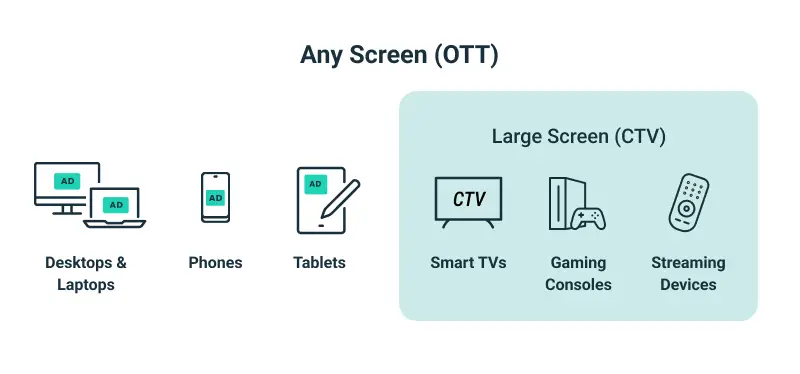
CTV and OTT are often used interchangeably, although there are a few key differences. OTT advertising describes any ad delivery that connects companies to their audiences over the internet, via streaming on devices such as desktops, laptops, phones and tablets, bypassing linear TV providers.
CTV is a device-type that serves OTT ads to customers. The devices include: Smart TVs, those with built-in internet connection and advertising platform, a streaming device, like Roku, that plugs into a TV to enable apps and streaming, and game consoles that stream, such as Xbox.
In short, all connected TV advertising is a form of OTT advertising, but not all OTT advertising is connected TV advertising. Understanding that distinction is the first step toward building a smarter media mix.
Why Should CTV and OTT Be In Your Media Mix?
Stakeholders outside the marketing team often ask why they should make room in the budget for CTV and OTT. They sometimes assume that if they invest in mobile advertising and linear TV ads, CTV and OTT would be redundant additions to their media mix. This couldn’t be further from the truth.
Audience behavior differs across OTT and CTV devices, and companies see different results based on where and how they run their ads. Here are the strongest reasons to add CTV and OTT advertising to your media mix:
- Comprehensive Marketing Funnel: Omnichannel marketing strategies are critical to successful ad campaigns. Audiences find their favorite brands through a variety of channels, and often have different levels of trust across those channels. In order to get the most return from marketing spend, companies need to include CTV and OTT ads.
- Audience Behavior: CTV devices, specifically, are designed to keep audiences’ attention. Our phones, tablets, and laptops all can (and are) used for multiple activities at once. CTV only allows for streaming, which increases audience engagement. What’s more, CTV ads aren’t skippable. Audiences are guaranteed to see your full ad when you invest in CTV.
- Reliable Reporting: Unlike linear TV or Out-of-Home advertising, CTV and OTT ads offer the level of performance reporting that companies expect from mobile and other digital ads. Companies demanding real business results from their marketing teams need accurate, verifiable reporting, and OTT advertising delivers exactly that.
Of course, the reasons a company decides to invest in CTV and OTT will be unique. But, the impact that these ads can make is universal.
How to Drive Foot Traffic and Other Business Results from CTV and OTT
As we mentioned, customers expect omnichannel marketing from their favorite brands. But companies also see better results when they combine a variety of channels to target their different audience segments.
For example, GroundTruth customers have seen a 2x increase in ROAS when they combine CTV ads with mobile ads. They also see a 61% increase in foot traffic using the same combination. Retargeting ads perform better when served alongside CTV and OTT advertising. The stronger your connected TV advertising presence, the more effectively your other channels work around it..
Learn More About CTV+ with GroundTruth
If you’re ready to put CTV and OTT advertising to work, contact us today! We’ll give you an exclusive look at our newest offering, CTV+, which combines the power of connected TV advertising with mobile ads to drive real, measurable results..
Frequently Asked Questions
What devices support OTT and connected TV advertising?
OTT advertising runs across a wide range of devices including desktops, phones, tablets, and smart TVs. Connected TV advertising specifically runs on television-connected devices like Roku, Amazon Fire Stick, Apple TV, gaming consoles like Xbox and PlayStation, and smart TVs with built-in streaming apps. The device mix you choose affects both your audience reach and your average cost per impression.
How much does OTT advertising cost?
OTT advertising is typically bought on a CPM (cost per thousand impressions) basis. Costs vary depending on the platform, audience targeting, and ad format, but generally range from $25 to $50 CPM. Connected TV advertising tends to run at a higher CPM than other OTT placements due to the larger screen size and higher engagement rates, but the tradeoff is a more attentive audience and non-skippable ad formats.
How do you measure the results of CTV and OTT advertising?
Beyond standard digital metrics like impressions and completion rates, CTV and OTT advertising can be tied to real-world outcomes. Platforms like GroundTruth measure foot traffic lift, store visits, and ROAS by connecting CTV ad exposure to location